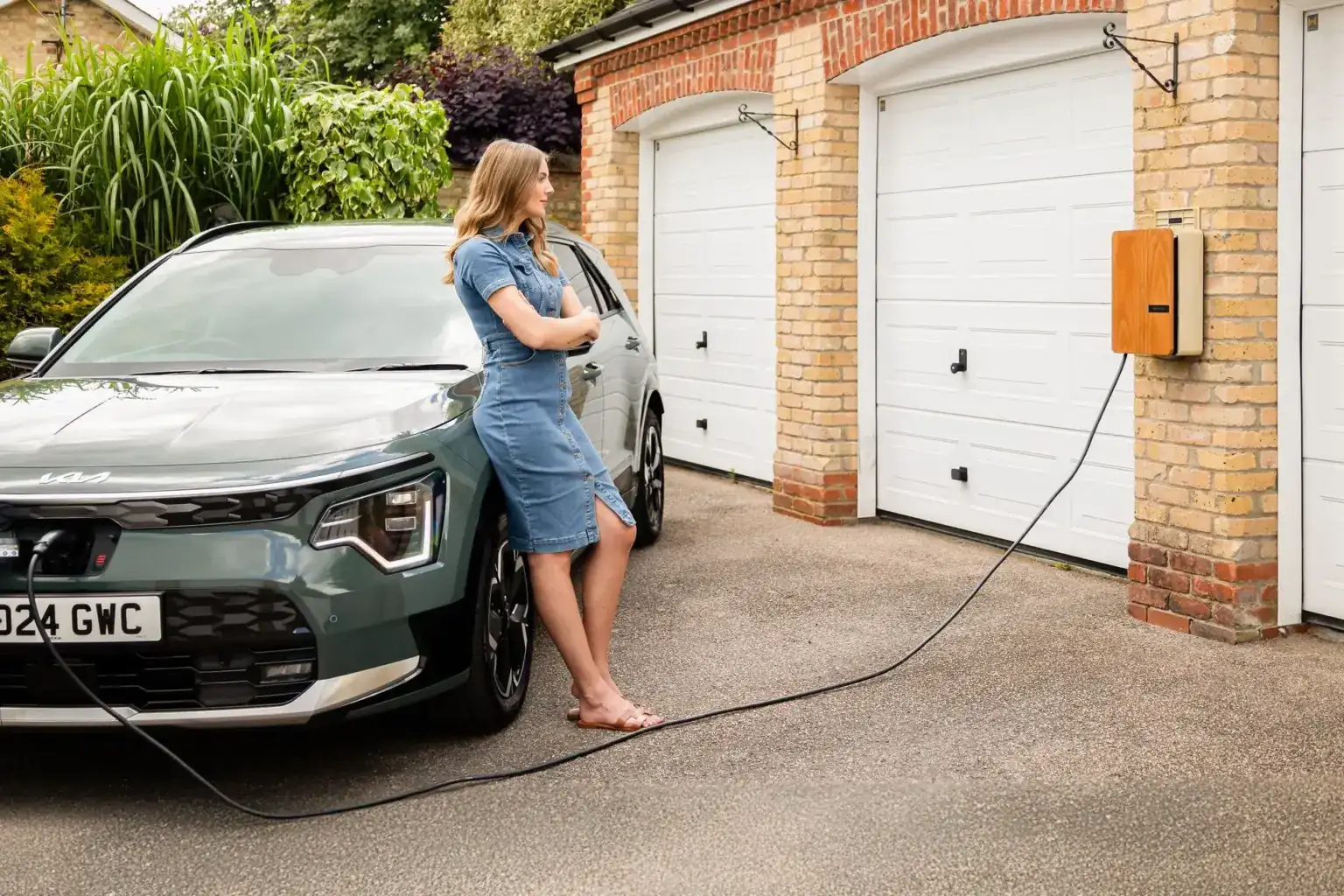
Most Federal Way EV owners want a Level 2 charger at home, on its own 240-volt circuit, sized to the car and to what the electrical panel can handle. Electrician Federal Way connects you with a licensed local electrician for EV charger installation in Federal Way, WA, from a simple NEMA 14-50 outlet in the garage to a hardwired wall charger with load management. Call (253) 555-0100 to get started.
This page walks through the choices that actually change your install: plug-in or hardwired, what amperage, whether your panel has room, the City of Federal Way permit, and the Puget Sound Energy (PSE) home charging program.
Level 1 vs Level 2 charging at home
Every EV can charge from a normal 120-volt outlet (Level 1), but it is slow. Level 2 uses a 240-volt circuit, like a dryer, and is what most drivers install. The right choice depends on how far you drive, not just what car you own.
| Level 1 | Level 2 | |
|---|---|---|
| Voltage | 120V standard outlet | 240V dedicated circuit |
| Typical use | Plug-in hybrids, short daily drives | Full EVs, commuters, 2-EV households |
| Charging speed | A few miles of range per hour | Many times faster, a full charge overnight for most cars |
| Electrical work | Often none, but a dedicated outlet is best | New circuit from the panel, permit required |
| Daily driving | Long I-5 commutes can outpace it | Handles commutes to Seattle, Tacoma, or Bellevue |
Plug-in outlet or hardwired charger?
A Level 2 charger (the proper name is EVSE, electric vehicle supply equipment) can plug into a 240-volt receptacle or be wired straight to the circuit. Both work well when installed correctly.
Plug-in (NEMA 14-50 or 6-50)
Easy to swap or take with you if you move. Limited to lower charging rates on a 50-amp circuit. Use a quality, heavy-duty receptacle, since cheap outlets can overheat under hours of steady load. Current code generally calls for GFCI protection on these outlets.
Hardwired wall charger
Allows higher charging rates, has no plug to wear out, and is the better choice for outdoor mounting in our wet climate. Many chargers can be set to a lower amperage if your panel is tight.
Whatever you choose, pick a UL listed charger. Your electrician can tell you if your car or charger has a specific requirement.
Circuit size and charger amperage
An EV charger is a continuous load under the National Electrical Code (NEC), so the circuit must be rated at 125% of what the charger draws. That is why a 48-amp charger needs a 60-amp circuit.
| Breaker / circuit | Max continuous charging | Typical setup |
|---|---|---|
| 20 amp, 240V | 16 amps | Small panel or light daily driving |
| 40 amp, 240V | 32 amps | Common hardwired or plug-in setup |
| 50 amp, 240V | 40 amps | NEMA 14-50 outlet or hardwired |
| 60 amp, 240V | 48 amps | Hardwired only, larger panels |
More amps is not always better. If you drive 30 to 40 miles a day, a 32-amp or 40-amp charger usually refills the battery overnight with room to spare.
Does your panel have room for an EV charger?
This is the biggest question in older Federal Way homes. Many houses in Twin Lakes, Lakeland, Steel Lake, and Mirror Lake date from the 1960s to 1990s and still have a 100-amp panel. Add an electric range, dryer, water heater, and heat pump, and there may be little left for a car.
Your electrician does a load calculation before quoting. Then there are usually 3 paths.
- It fits: the panel has space and capacity, and the charger goes on a new circuit.
- It fits with load management: a load management device or a smart charger setting limits charging when the house is using a lot of power, which can avoid a service upgrade.
- It needs an upgrade: the panel is full, outdated, or undersized, so a panel replacement or 200-amp service upgrade comes first.
PSE also suggests calling its Customer Construction Services team before you install if you are unsure about capacity, since a larger service involves the utility.
Planning a home EV charger?
Tell us your car, your panel size, and where you park. We will connect you with a licensed electrician in Federal Way.
How EV charger installation works in Federal Way
Site visit and load check
Your electrician looks at the panel, the route to the parking spot, and the wall or post where the charger will mount, and runs a load calculation.
Choose charger and location
Decide plug-in or hardwired, amperage, and mounting spot. Think about cable reach to both cars if you might add a second EV.
City of Federal Way permit
Federal Way issues its own electrical permits and inspections, so the permit comes from the City’s Building Division, not from L&I. Simple electrical permits can be applied for through MyBuildingPermit.
Install the circuit
A new breaker, correctly sized wire, and conduit where needed, run to the charger or receptacle. Outdoor runs use wet-rated parts.
Inspection and setup
The City inspects the work. Your electrician sets the charger’s amperage to match the circuit, and you can connect it to Wi-Fi or an app if it has one.
Washington requires the electrician doing the work to be certified, and the contractor to be licensed, by the WA Department of Labor and Industries (L&I). Ask to see both.
Where to put the charger
Garage installs are the simplest, especially when the panel is on a shared garage wall. Other common setups around Federal Way include:
- Attached garage near the panel
- Exterior wall by the driveway
- Detached garage or carport (often needs a trench or subpanel)
- Pedestal in a long driveway
- Townhome or condo stall (HOA approval first)
- Shop or ADU with its own subpanel
Outdoor chargers should be rated for outdoor use (look for NEMA 3R or 4 on the enclosure). Federal Way’s damp, rainy fall and winter make this important. Keep the cable off the ground where you can, and add a holster or hook.
PSE home charging program
Federal Way homes are served by Puget Sound Energy. PSE runs an Up and Go Electric home charging program that offers rebates on qualified Level 2 chargers for residential PSE customers who own, lease, or have ordered an EV. Income-qualified households may get a larger rebate and help with installation. PSE also runs Flex EV, which pays you for letting a connected charger shift charging times during peak events.
Program rules, eligible chargers, and amounts change, so check PSE’s home charging page before you buy the charger. Buying a qualifying model can make a real difference.
What affects the cost of EV charger installation
We do not list prices because every garage and panel is different. These are the factors that move the quote.
| Cost factor | What to expect |
|---|---|
| Distance from panel to charger | Longer wire runs, especially in heavy gauge, cost more. |
| Panel capacity | A load management device or panel upgrade adds to the job. |
| Wall and route | Finished walls, ceilings, or a trench to a detached garage add labor. |
| Charger type | Plug-in outlet vs hardwired unit, and the charger you buy. |
| Outdoor install | Wet-rated conduit, boxes, and a pedestal if needed. |
| Permit | The City of Federal Way electrical permit fee. |
EV charging for businesses and multifamily
Workplaces, retail lots, and apartment or condo buildings need a different plan, often with networked chargers, load sharing, and more capacity. See commercial electrical service and tell us about the property when you call.
Electrician Federal Way helps drivers across 98003, 98023, and 98001, from Dash Point and Redondo to West Campus and the Commons area. We also connect homeowners in nearby cities, see service areas. Adding a charger is also a good time to think about whole-home surge protection for the car and the charger.
EV charger installation FAQs
Do I need a permit to install an EV charger in Federal Way?
Yes, a new 240-volt circuit for a Level 2 charger needs an electrical permit. Inside Federal Way city limits, the permit and inspection come from the City of Federal Way, not L&I. Your electrician normally handles it.
Can I install a Level 2 charger on a 100-amp panel?
Often yes, but it depends on your other loads. A load calculation will show whether the charger fits as is, fits with load management or a lower amperage setting, or needs a panel upgrade first.
Is a NEMA 14-50 outlet or a hardwired charger better?
A plug-in outlet is flexible and easy to replace. A hardwired charger can charge faster, avoids plug wear, and suits outdoor installs. Many electricians prefer hardwired for daily heavy use.
What size breaker does an EV charger need?
The breaker must be 125% of the charger’s continuous current. A 32-amp charger needs a 40-amp circuit, a 40-amp charger needs 50 amps, and a 48-amp charger needs 60 amps.
Does PSE offer a rebate for home EV chargers?
PSE has offered rebates through its Up and Go Electric home charging program for qualified Level 2 chargers, with extra help for income-qualified customers. Check PSE’s website for current terms before you buy.
Can I install a charger outside?
Yes, with an outdoor-rated charger, wet-rated wiring methods, and the right mounting. In Federal Way’s rainy season, a hardwired outdoor unit is usually the better choice than an exposed plug.
Can I add a charger in a condo or townhome?
Usually, but you will need HOA or property manager approval and a way to meter the power. Tell us about the building when you call so the right electrician is matched to the job.